


Using AI Infrastructure for Genomics and Drug Discovery: When Private Cloud Wins
Private cloud wins for genomics AI at scale - cut costs, control compliance, and boost GPU utilization with a 90–120 day deployment plan.
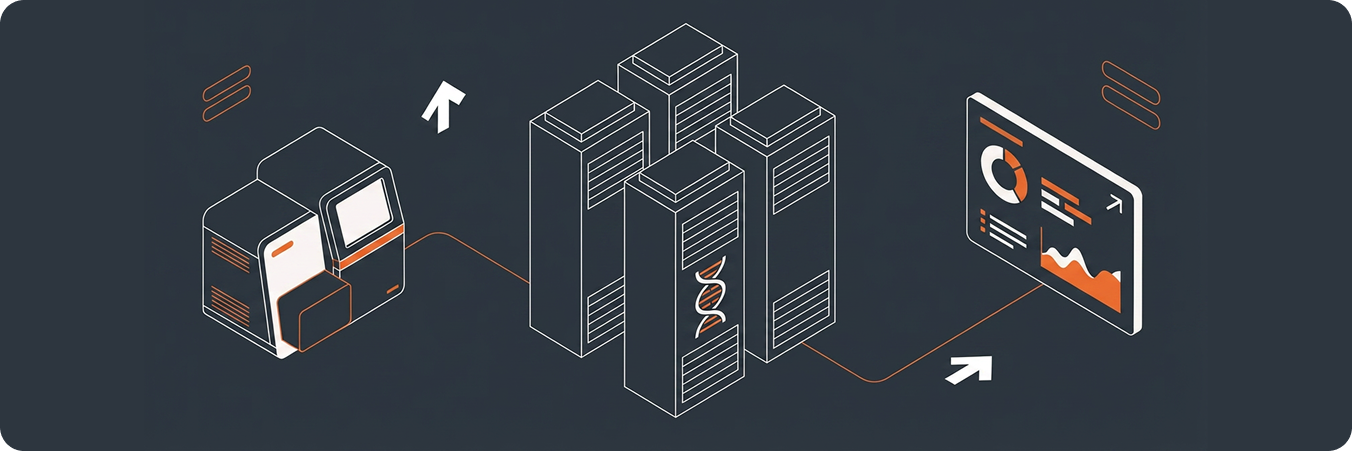
Genomics and drug discovery AI workloads push past public cloud limits at clear points. This often happens when you run large clusters for a long time (more than 512 GPUs), when data egress costs reach $100,000 per month, or when rules require clear proof that you control PHI and can validate GxP systems. This guide explains six measurable decision criteria, the stack you need for petabyte-scale genomics pipelines, and a realistic 90–120 day private rollout plan. That plan can deliver better cost and better day-to-day results than hyperscale cloud.
The decision in one page: | Private vs public cloud
If you are choosing where to run genomics and drug discovery AI, the choice is not about beliefs. It is about measurable operating limits. Once your workloads cross certain lines, public cloud “one-size-fits-most” layers stop working well.
Private cloud “wins” when it gives steady performance, keeps compliance under your control, and lowers cost per useful GPU-hour over 36 months. You can judge this with six measurable thresholds:
Data residency: PHI requiring HIPAA compliance, GxP validation needs, data sovereignty requirements
Performance consistency: Sustained clusters above 512 GPUs where noisy-neighbor effects add up
Model flops utilization: MFU targets above 60% for cost-effective training
Data movement costs: Monthly egress fees exceeding $100,000
Storage contention: Shared storage causing GPU idle time above 40%
Deployment timeline: Validated infrastructure running within 90–120 days
When three or more thresholds apply, private cloud usually gives better cost and better operations than public cloud for genomics AI.
Why genomics and drug discovery _ are different
Genomics and drug discovery workloads stress infrastructure in ways most AI apps do not. The main difference is data gravity, with the industry producing 220 million genomes annually.
For example, a chatbot loads a model once and then serves requests. In contrast, genomics pipelines read the same huge datasets many times across preprocessing, training, and analysis. As a result, you get long, heavy load patterns that expose weak points in shared cloud designs.
Consider this: One whole-genome sequence produces 100–150 GB of raw data. Now multiply that by thousands of samples, add variant calling and annotation, and then add model training. In practice, you end up with sustained multi-petabyte working sets, not just stored archives.
These workload patterns stress specific parts of the stack. Next-generation sequencing pipelines switch between CPU-heavy alignment and GPU-accelerated variant calling, processing 5 million variants per whole genome analysis. Protein structure prediction can run GPU training for days, and then burst CPU use for validation. Drug discovery models can train on molecular datasets with millions of small files, which can overload metadata services.
Because of this, multi-tenant systems designed for “average” workloads can struggle. When an NGS pipeline needs 40 GB/s sustained read throughput, shared storage can become the limit. Similarly, when a protein folding job needs stable network behavior across 1,024 GPUs, noisy neighbors can slow training.
When private cloud | beats hyperscale cloud
Private cloud is not always better than public cloud. Instead, it wins when certain measurable limits are reached. These are practical breakpoints where public cloud layers stop being efficient.
Data and compliance thresholds
Regulated genomics workloads can hit compliance limits where private cloud becomes the safer choice. Under HIPAA, Protected Health Information requires clear proof of where data is stored, who controls encryption keys, and what audit trails exist. In other words, you cannot only assume your data stays in a region, you must be able to prove it to auditors.
On top of that, GxP validation for drug discovery adds more requirements. FDA 21 CFR Part 11 calls for validated systems with complete audit trails kept for 7–10 years. That means every infrastructure change, every software update, and every access event must be recorded.
Common regulatory triggers include:
HIPAA requirements: PHI data residency, encryption key control, BAA limitations
21 CFR Part 11: System validation, electronic signatures, audit trail integrity
GDPR compliance: Data localization, right to deletion, processing transparency
Institutional policies: Vendor risk assessments, data classification requirements
When these requirements stack up, the effort to stay compliant in public cloud can cost more than running private infrastructure.
Performance and scale thresholds
Performance limits show up when clusters get large enough that consistency matters more than “peak” specs. At 512 GPUs or more, small swings in network latency or storage throughput can add up to large changes in training time.
Model flops utilization (MFU) is one of the clearest measures. Public cloud setups often land at 40–50% MFU because storage and network behavior can vary. In contrast, private systems with matched storage and stable networking can push MFU above 60%. That gain usually means faster training and lower cost per epoch.
Checkpoint behavior shows another limit. Large genomics models often checkpoint every 30–60 minutes to reduce risk from failures. However, in shared storage systems, checkpoint writes can compete with training reads and slow everything down. If checkpoint overhead goes above 10% of training time, private infrastructure with dedicated storage bandwidth is often the better option.
Cost and data movement thresholds
Data movement can quietly make public cloud expensive for genomics. Egress fees look small at first, but they grow fast when you move 100 TB datasets between regions or back to on-prem systems for analysis.
This problem often gets worse because of the “always bursting” pattern. Teams plan to use cloud only for temporary peaks. Yet genomics workloads rarely follow neat cycles, so data moves in and out again and again. As a result, you may pay egress fees many times for the same datasets.
Example: A drug discovery platform that processes 10 TB of new sequence data per day can face layered costs. The data may move from sequencers to cloud storage, then between regions for processing, and then to on-prem systems for analysis. In this case, monthly egress can reach $72,000 for one large study.
What genomics AI workloads | need from the stack
Genomics AI infrastructure works best as a matched system. Each layer must support sustained throughput, not only peak numbers. In general, the stack has three key layers, and you need to design them together.
Compute: Right nodes for each stage
Genomics pipelines use different compute at different stages. GPU nodes handle model training, protein structure prediction, and accelerated sequence alignment. Meanwhile, CPU nodes handle preprocessing, ETL pipelines, and validation workflows.
Compute needs depend on inputs such as batch size, sequence length, checkpoint timing, and which pipeline stages you run. Larger batches can improve GPU use, but they need more memory. Longer transformer sequences need more GPU memory and bandwidth. More frequent checkpoints require faster storage writes.
A common cluster mix is about 80% GPU nodes for training and inference, plus about 20% high-memory CPU nodes for preprocessing. Those CPU nodes often need 1–2 TB of RAM to handle reference genome indexing and intermediate structures that do not fit in GPU memory.
Network: Deterministic east-west for collective ops
Network fabric depends on how your workloads communicate. When you train large models, you often use all-reduce. In all-reduce, every GPU exchanges gradients with many other GPUs. That creates heavy east-west traffic that standard datacenter networks often handle poorly at scale.
InfiniBand offers very low latency, around 5 microseconds, so it fits tightly coupled training. High-performance Ethernet with RoCE can reach about 7–10 microseconds. That works well for many genomics workloads and can also support multi-tenancy more easily.
In production, “good” often looks like stable NCCL bandwidth above 90% of the theoretical maximum under sustained load. To reach that, you usually need careful topology design, including supernode patterns that keep related GPUs on the same network segment.
Storage: Throughput and metadata at scale
Genomics workloads stress storage in three main ways. First, millions of small files can overload metadata services. Second, distributed training needs fast parallel reads with high sustained throughput. Third, frequent checkpoints need steady write speed without blocking reads.
Common architecture options include:
VAST Data: Optimized for random access patterns with consistent low latency
WEKA: Delivers parallel file system performance for sustained throughput
Lustre: Proven in HPC environments for large sequential access
Sizing targets for genomics often include 20–40 GB/s per-node read rates to avoid GPU starvation, a 10–20 GB/s checkpoint write budget to keep checkpoints under 5% of training time, and 100K+ metadata operations per second to handle small-file access without bottlenecks.
Compliance and auditability _ in practice
To make compliance work, you need “show me the evidence” features built in from day one. The goal is to support audits and validation without slowing research.
HIPAA, GxP, and 21 CFR Part 11: What changes in private design
Private cloud design changes several choices for regulated workloads. For example, data residency becomes physical and specific. You can point to the exact datacenter, rack, and drives that store the data. In addition, key custody can stay internal by using hardware security modules that you control, instead of managed key systems where the provider holds root keys.
Identity and access management also changes. You typically need privileged access management that records every admin action. This is more than basic logs. It is meant to create evidence that can hold up legally. For GxP, evidence retention can extend to 7–10 years, so you also need archival storage built for compliance.
Pipeline integrity and lineage tracking also need infrastructure support, such as:
Immutable audit logs: Every API call, job submission, data access
Version control: Infrastructure as code with change validation
Data lineage: Tracking from raw sequences through trained models
Compute attestation: Proving which hardware ran which workloads
In private cloud, you can show compliance through direct evidence, not only vendor claims.
Economics over 36 months: | What actually moves TCO
A realistic cost comparison focuses on cost per useful GPU-hour, not list price. “Useful” means the GPU is doing work, not waiting on data. Over 36 months, two factors usually dominate TCO.
Utilization and performance as first-order cost drivers
Higher MFU from steadier I/O can change the math, with optimized systems achieving 57% improvement in training throughput from software improvements alone. For instance, 65% MFU delivers about 30% more useful work than 50% MFU. That means you need fewer GPU-hours for the same training run.
This makes the tradeoff clearer. Paying more for better network and storage can reduce overall cost compared with “cheaper GPUs” that sit idle. A private cluster with InfiniBand and parallel storage might cost 20% more per GPU than public cloud. However, if it delivers 40% better utilization, the cost per trained model can still drop.
Your operating model also affects results. A dedicated ops team costs more up front, but it can raise utilization through tuning. Managed services have variable cost and steady, but not fully optimized, performance. Self-service can cost less, but it can also lead to poor utilization without the right skills.
Data gravity and egress: The hidden multiplier
Data gravity creates compounding costs that do not show up in simple GPU price checks, with 62% of IT leaders exceeding cloud budgets due to unexpected egress fees. For example, a drug discovery platform that processes 10 TB of new sequence data daily must move data from sequencers to cloud storage, between regions for processing, and to on-prem systems for analysis.
If total daily movement is 30 TB across ingress, processing, and egress, monthly egress can reach $72,000. Annual egress can reach $864,000. Over 36 months, egress alone can exceed $3.1 million.
That single cost can exceed the full TCO of private infrastructure. In addition, if you repeatedly rehydrate datasets from cold storage and keep a steady “burst” pattern, data movement can become the main cost driver.
A realistic _ 90-120 day private deployment plan
Fast rollout with real validation takes disciplined work across three phases. Each phase has deliverables and validation gates. If you skip them, you increase risk.
Phase 1: _ Site and requirements lock
The first 30 days focus on locking the non-negotiables. Power and cooling limits set the cluster size. Modern GPUs can require 50–150 kW per rack, so you must confirm both power capacity and cooling capability.
Next, security and compliance mapping identifies which frameworks apply and what they require from infrastructure. Then, clear acceptance criteria prevents later scope creep. This includes performance benchmarks, availability SLOs, compliance evidence needs, and ops handoffs.
Phase 2: _ Build, integrate, and validate
Days 31–75 cover the build and integration. Order matters. Typically, you bring up power and cooling first, then network fabric, then compute and storage, and finally the orchestration layer. Also, each layer needs validation before you move on.
Validation tests that matter include NCCL bandwidth tests for all-reduce at full scale, storage benchmarks for sustained read/write under parallel load, failure tests for node loss and network partitions, and checkpoint/recovery timing at full cluster scale.
These tests are practical, not theoretical. A cluster can pass vendor benchmarks and still fail on your real workload patterns.
Phase 3: _ Cutover and hybrid operations
Days 76–120 cover production cutover and hybrid setup. Migration usually follows this order: pipelines first, then training jobs, and finally inference services. This order lowers risk and lets you validate each workload type as you go.
Hybrid burst setup also needs careful identity and network design. Identity federation between private and cloud must keep compliance boundaries. Network routing must prevent accidental leakage while still allowing approved burst use cases.
Finally, SLOs and runbooks complete the rollout. This includes performance targets for job completion times, uptime and recovery requirements, failure response steps, and compliance steps for audits.
How WhiteFiber supports private _ and hybrid for life sciences
WhiteFiber’s life sciences approach centers on engineered systems that provide steady performance and clear operations. Instead of stitching together commodity parts, we design the system as a matched stack for genomics and drug discovery.
Private infrastructure built for density and consistency
Our AI-native facilities support the power density genomics clusters need: up to 150 kW per cabinet with direct liquid cooling. This is purpose-built for dense GPU deployments, not retrofitted datacenter space.
We also design the network topology for stable performance. Our scheduled Ethernet reaches 97.5% of theoretical bandwidth under load. That is close to InfiniBand-level performance while still supporting multi-tenant isolation. In addition, storage is sized to feed GPUs at full speed, with 40 GB/s per node read throughput.
Operational SLOs support these capabilities with 99.95% uptime for production workloads. This comes from 2N power redundancy, N+1 cooling, and proactive monitoring that can detect issues before they affect jobs.
Hybrid bursting without breaking governance
WhiteFiber Cloud adds elastic capacity for burst needs while keeping governance boundaries. When your private cluster is full, workloads can burst to our cloud without moving data or breaking compliance.
Transparency is a key difference. You get direct visibility into power, cooling, network use, and storage throughput. This goes beyond a simple dashboard and includes telemetry access so you can confirm performance and troubleshoot yourself.
Compliance support is also built in. We maintain SOC 2 Type II certification and support HIPAA-compliant deployments. Audit logs record every access and configuration change, with retention that matches your regulatory needs.
FAQ: _ Private cloud AI for genomics
When does private cloud AI infrastructure outperform public cloud for genomics workloads?
Private cloud wins when you hit data residency requirements, need sustained clusters above 512 GPUs, require MFU targets above 60%, or face egress costs exceeding $100k monthly.
Which network fabric should genomics teams choose for AI workloads?
InfiniBand for latency-sensitive training with frequent collective operations; high-performance Ethernet for mixed workloads requiring operational flexibility and multi-tenancy.
How much storage throughput do genomics AI models actually need?
Plan for 20–40 GB/s per node read rates to prevent GPU starvation, with checkpoint write budgets matching your recovery time objectives and small-file handling for metadata-heavy workflows.
How do we meet HIPAA and GxP requirements in hybrid cloud deployments?
Control key custody and data residency in private infrastructure while maintaining unified identity management and audit trails across both private and cloud environments.
What does a 90-120 day private cloud rollout timeline include?
Phase 1 covers site preparation and requirements lock, Phase 2 handles build and validation testing, Phase 3 manages cutover sequencing and hybrid operations setup.
How should we model 36-month TCO for private versus public cloud?
Focus on sustained GPU utilization rates, data egress patterns, operational staffing models, and performance consistency impacts rather than simple per-hour pricing comparisons.
Get a private cloud threshold assessment
Bring your dataset sizes, pipeline descriptions, compliance constraints, and current cloud bills. We will return fabric and storage sizing recommendations, utilization forecasts, and a deployment timeline that fits your operational reality.
.png)
.svg)
