
Ethernet vs. InfiniBand: The Evolving Landscape of High-Performance Networking
Ethernet is now competing head-to-head with InfiniBand for AI and HPC workloads. Explore the performance differences, advancements like DriveNets Network Cloud, and what the future holds for both technologies.
15 min read
Last updated:
April 7, 2025

Introduction
In today's data-driven world, the backbone of computing infrastructure - networking technology - plays a crucial role in determining overall system performance. Two technologies have dominated the high-performance networking landscape: Ethernet and InfiniBand. While InfiniBand has traditionally been the go-to solution for high-performance computing (HPC) and artificial intelligence (AI) workloads, recent advancements in Ethernet technology, particularly with innovations like DriveNets Network Cloud, are challenging this status quo.
This article explores the differences, performance characteristics, and future trajectories of both technologies, with a particular focus on how modern Ethernet implementations can match or even exceed InfiniBand performance in many scenarios.
Understanding Ethernet: The Universal Standard
Ethernet has been the dominant networking technology in enterprise and consumer applications for decades. Developed in the 1970s and standardized in 1983, Ethernet has continuously evolved to meet increasing bandwidth demands.

Understanding Ethernet: The Universal Standard
Ethernet began with 10 Mbps speeds and has progressed through multiple generations: 100 Mbps (Fast Ethernet), 1 Gbps (Gigabit Ethernet), 10 Gbps, 25 Gbps, 40 Gbps, 100 Gbps, 200 Gbps, 400 Gbps, and now 800 Gbps. The IEEE 802.3 working groups continue to develop standards for even higher speeds, with 1.6 Tbps (Terabit Ethernet) on the horizon.
Modern Ethernet implementations incorporate numerous enhancements beyond raw speed increases:
Priority Flow Control (PFC):
Enables lossless operation for selected traffic classes
Enhanced Transmission Selection (ETS):
Provides bandwidth allocation for different traffic types
Data Center Bridging Exchange (DCBX):
Automates configuration of these features
RoCE (RDMA over Converged Ethernet):
Brings Remote Direct Memory Access capabilities to Ethernet
These enhancements have transformed Ethernet from a best-effort network protocol to one capable of supporting the most demanding applications.
Ethernet's Strengths
Ethernet's widespread adoption has created several inherent advantages:
Ubiquitous ecosystem:
Vast array of hardware options from multiple vendors
Cost efficiency:
Economies of scale drive down hardware costs
Standardization:
IEEE-governed standards ensure interoperability
Flexibility:
Supports diverse applications from edge to data center
Mature management tools:
Extensive monitoring and troubleshooting capabilities
Multi-tenancy support:
Well-established mechanisms for network segmentation
Understanding InfiniBand: The HPC Specialist
InfiniBand emerged in the early 2000s specifically designed for high-performance computing applications where latency and deterministic performance are paramount.
Technical Foundation and Evolution
InfiniBand was built from the ground up with performance in mind. Its evolution has been marked by increasing data rates:
InfiniBand's Traditional Advantages
InfiniBand has historically excelled in:
- Ultra-low latency: Typically 3-5 microseconds compared to traditional Ethernet's 20-80 microseconds
- Deterministic performance: Consistent behavior under load
- Efficient small packet handling: Critical for many HPC applications
- Specialized optimizations: Tuned for specific workloads like AI training
- Hardware offload capabilities: Reduces CPU overhead
Performance Comparison: Closing the Gap
The performance gap between Ethernet and InfiniBand has narrowed significantly in recent years. Let's examine key metrics:
Bandwidth Evolution
Both technologies have followed similar bandwidth progression paths, with current generations offering 400 Gbps and upcoming standards reaching 800 Gbps and beyond. The chart below illustrates this parallel evolution:
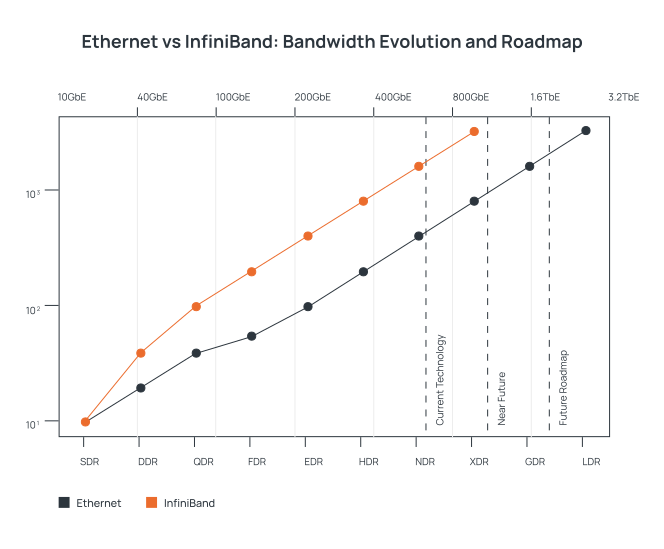
As shown, both technologies are on similar trajectories, with Ethernet sometimes leading in standardization while InfiniBand occasionally leading in implementation.
Latency Comparison
Latency has traditionally been InfiniBand's strongest advantage. However, modern Ethernet implementations, particularly with technologies like DriveNets Network Cloud-AI, have dramatically reduced this gap:
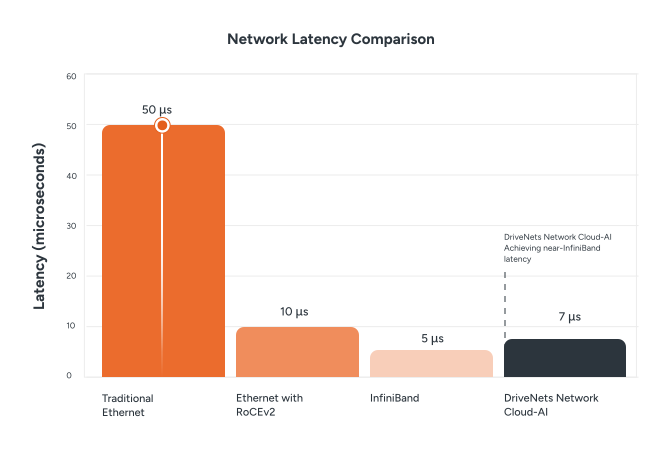
While traditional Ethernet exhibits latencies around 50 microseconds, RoCEv2 implementations reduce this to approximately 10 microseconds. DriveNets Network Cloud-AI further reduces latency to just 7 microseconds, approaching InfiniBand's 5 microsecond latency.
Real-World Performance
In practical applications, particularly AI workloads, the performance difference between optimized Ethernet and InfiniBand has become statistically insignificant in many cases:
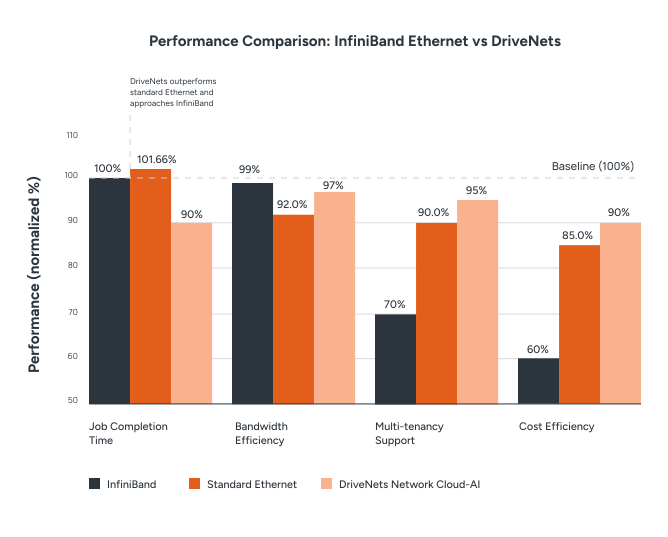
Independent testing by organizations like WWT has shown that:
These results challenge the conventional wisdom that InfiniBand is necessary for high-performance AI workloads.
The Single vs. Multi-Tenancy Consideration
One critical factor in choosing between Ethernet and InfiniBand is whether the network will serve a single application or multiple tenants.
Single-Tenant Environments
In dedicated, single-tenant environments like traditional HPC clusters:
However, even in single-tenant scenarios, Ethernet with technologies like DriveNets is now competitive on performance while offering cost advantages at scale.
Multi-Tenant Environments
For multi-tenant environments like cloud providers or shared enterprise infrastructure:
The performance comparison chart shows that DriveNets-enhanced Ethernet provides 95% multi-tenancy support compared to InfiniBand's 70%, making it the superior choice for shared environments.
The DriveNets Effect: Transforming Ethernet Performance
DriveNets Network Cloud represents a paradigm shift in networking architecture that has dramatically improved Ethernet performance, particularly for AI workloads.
Architectural Innovation
DriveNets Network Cloud is built on four key principles:
This architecture enables several performance advantages:
DriveNets Network Cloud-AI
The AI-specific implementation, DriveNets Network Cloud-AI, further enhances Ethernet performance:
Scheduled Fabric:
Replaces traditional Clos architecture with a deterministic, cell-based fabric
Perfect Load Balancing:
Ensures optimal distribution of traffic across the fabric
Massive Scale:
Supports up to 32,000 GPUs in a single cluster
High-Speed Connectivity:
Each GPU connected with 800 Gbps Ethernet
Independent testing has shown that DriveNets Network Cloud-AI improves job completion time by 10-30% compared to traditional Ethernet fabrics, bringing performance on par with or exceeding InfiniBand in many scenarios.
Pros and Cons Analysis
Future Trends: Convergence or Divergence?
Ethernet's Evolution
InfiniBand's Path Forward
The Impact of DriveNets and Similar Technologies
The historical pattern suggests that open, standards-based solutions (like Ethernet) tend to win in the long term, especially as performance differences diminish.
Conclusion: Making the Right Choice
The decision between Ethernet and InfiniBand is no longer simply about performance. With technologies like DriveNets Network Cloud, Ethernet can now deliver performance comparable to InfiniBand while maintaining its advantages in cost, flexibility, and ecosystem support.
For organizations building new infrastructure, particularly for AI workloads, the key considerations should be:
In many cases, modern Ethernet with technologies like DriveNets will provide the optimal balance of performance, cost, and flexibility. InfiniBand remains a strong choice for specialized workloads with extreme performance requirements, but its advantages continue to narrow as Ethernet evolves.
The networking landscape is no longer a clear-cut division between "Ethernet for general use" and "InfiniBand for performance." Instead, we're entering an era where enhanced Ethernet can serve the full spectrum of networking needs, from everyday enterprise applications to the most demanding AI workloads.
FAQ:
Is InfiniBand still faster than Ethernet for AI training workloads?
In many real-world tests, the difference is smaller than expected. WWT benchmarks showed that in MLPerf Training with BERT-Large models, Ethernet actually outperformed InfiniBand by a small margin. In inference tests with LLAMA2-70B, InfiniBand was only 1.66% faster. The performance gap that once defined the choice between the two has narrowed significantly with modern Ethernet implementations.
What is RoCE and why does it matter for this comparison?
RoCE, or RDMA over Converged Ethernet, brings Remote Direct Memory Access capabilities to Ethernet networks. It allows data to move directly between systems without involving the CPU, which was previously one of InfiniBand's key advantages. RoCEv2 implementations reduce Ethernet latency to around 10 microseconds, compared to InfiniBand's roughly 5 microseconds, making Ethernet viable for workloads that previously required InfiniBand.
What is scheduled fabric Ethernet and how does it differ from standard Ethernet?
Scheduled fabric replaces the traditional Clos network architecture used in most Ethernet deployments with a deterministic, cell-based approach. Instead of traffic competing for paths through the fabric, it is allocated in advance, which eliminates congestion and enables consistent, predictable performance at scale. DriveNets Network Cloud-AI, for example, uses this approach to support up to 32,000 GPUs in a single cluster with each GPU connected at 800 Gbps.
When should I still choose InfiniBand over Ethernet?
InfiniBand remains a strong choice for tightly coupled HPC workloads where sub-5-microsecond latency and in-network computing capabilities matter, and where the entire fabric is dedicated to a single tenant and workload type. For multi-tenant environments, mixed workloads, or organizations that want to avoid vendor dependency, modern Ethernet with the right architecture is now a credible alternative.
References

.svg)
