
What Is a Multi-Site GPU Cluster?
A multi-site GPU cluster runs two data centers as one. See how WhiteFiber Continuum™ delivers 136 Tbps at 0.9 ms latency across 83 km.

A multi-site GPU cluster is two or more physical data centers engineered to run as one logical GPU cluster, so a job can span sites without being rewritten for them. It matters because power, space and cooling cap how large a single site can get, and the usual workaround, a second separately managed deployment, pushes the coordination work onto your team.
WhiteFiber Continuum™ is a multi-site GPU cluster built this way across two Atlanta-area facilities. This post explains what the approach requires, what we have measured, and where its limits are.
What a Multi-Site GPU Cluster Requires
Linking two data centers with a fast circuit is the easy part. The hard part is making the link behave like the inside of a data center. Training and inference traffic depends on ordered, lossless RDMA delivery. Over an ordinary inter-site link, teams typically fall back on federated training, software changes and new operating processes to keep jobs running.
The design goal of a multi-site cluster is to remove that fallback. In the words of WhiteFiber Principal Architect Boris Lukashev, the aim is "a unified cluster that appears to be the exact same RDMA fabric we would normally see within a data center," so training does not need a federated mechanism.
Distance does not disappear. An 83 km fiber run introduces round-trip latency that no switch can eliminate. What the architecture controls is everything else: capacity, burst handling, load balancing, and data placement.
How WhiteFiber Continuum™ is Built
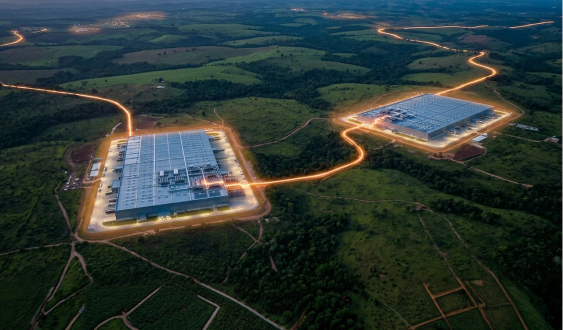
Continuum connects WhiteFiber's QTS ATL1 (Atlanta) and QTS SUW1 (Suwanee) facilities, 83 km apart, over 12 dark fiber strands leased from Zayo. A Ribbon Communications DWDM system lights the fiber with 170 channels of 800G ZR+ coherent optics, for 136 Tbps of aggregate bandwidth. Measured in production, round-trip latency across the span is 0.9 milliseconds, close to what light in fiber allows over that distance.
The architecture stack has four layers:
Optical transport– dark fiber plus the Ribbon DWDM line systemAI compute and storage– 256 NVIDIA H200 GPUs per site (512 total), with WEKA NeuralMesh handling dataAI-aware network fabric– DriveNets AI Fabric on Broadcom's Jericho3-AI and Ramon3 chipsets, using scheduled cell-based Ethernet instead of hash-based load balancingFacilities– two HITRUST-certified QTS data centers
Two design choices make the distance workable. HBM-buffered leaf switches sit where each site's fabric meets the inter-site link and absorb the burst when every GPU sends gradients at once, before it becomes congestion or packet loss. And WEKA NeuralMesh pulls the data a job needs to the site where its GPUs land, rather than mirroring everything in lockstep.
Watch: Toby Ford on Scale-Across Architecture
Toby Ford, Head Design Architect at WhiteFiber, walks through how Continuum's scale-across architecture supports workloads across multiple sites today, and what changes as it expands.
In Toby's words: "Today, we have a single setup between two sites. We're soon to expand into multiple sites where we have three or more in a hub and spoke model or in a mesh configuration, which allows us to use data center capacity in smaller modular units, combine them together into one larger fabric."
Beyond two sites
Continuum runs on two sites today. WhiteFiber plans to add sites in a mesh or hub-and-spoke layout, which would let us combine smaller blocks of data center capacity into one fabric instead of depending on a single large campus.
The Jericho3-AI fabric is designed for clusters of up to 32,000 GPU endpoints, about 62 times today's 512. That is design capacity, not deployed or tested capacity. Broadcom's Jericho4 generation points to larger clusters, lossless RDMA beyond 100 km, and line-rate MACsec encryption on every port.
Who this Fits
A multi-site GPU cluster isn't the right fit for every AI infrastructure buyer. It tends to matter most for:
Frontier model labs and AI research teamswhose training runs have outgrown a single site's power envelopeGPUaaS and NeoCloud providersthat want pooled capacity and an uptime story for their own customers without building multi-site engineering themselves.Regulated enterprisesin finance and life sciences that need provable dual-site resiliency and jurisdictional data control, backed by facility-level certificationTelco and edge operatorslooking to monetize existing distributed infrastructure, central offices and fiber investment, as GPU capacitySovereign AI and government workloadsthat need compute to stay within national or jurisdictional borders without depending on a single site for critical workloads
FAQ
What is a multi-site GPU cluster?
Two or more physical data centers operated as a single logical GPU cluster, rather than as separately managed deployments joined by a network link.
How is it different from just linking two data centers?
A plain network link leaves you with two systems: you split workloads, coordinate jobs across a slower connection, and fail over by rerouting. A multi-site cluster extends one RDMA fabric across both sites so a job can span them or move between them.
What performance does Continuum deliver?
136 Tbps of aggregate bandwidth at 0.9 ms round-trip latency over 83 km of dark fiber, measured in production.
Does running a GPU cluster across multiple sites compromise data sovereignty or compliance?
No. Continuum is built to keep sensitive workloads within their originating jurisdiction even while failover and pooled compute happen across sites, so regulated enterprises get resilience without giving up data residency.
Is WhiteFiber Continuum available today?
Yes. WhiteFiber Continuum has been commercially available since September 23, 2026.
How far can a multi-site cluster scale?
Continuum is two sites and 512 GPUs today. The fabric is designed for far larger clusters, and more sites are planned. The practical limits are how many sites, how much power, and how far apart they can be while keeping lossless RDMA.