
WhiteFiber Continuum Is Here: Bandwidth Is No Longer a Design Constraint on AI Infrastructure
WhiteFiber Continuum, our cross-data-center networking solution, is now commercially available turning two distributed clusters into one logical GPU supercluster.

15 min read
Last updated:
September 18, 2026
Back in July, we published some numbers that made a few people do a double take: 136 Tbps of aggregate bandwidth and 0.9 milliseconds of round trip latency, across 83 kilometers of dark fiber connecting two data centers. At the time, it was an R&D result: proof that two facilities could operate as one supercluster instead of two systems pretending to be one. We said we'd have more to share on availability, architecture, and final testing alongside commercial launch. Here it is.
Today, we are announcing that WhiteFiber Continuum is commercially available.
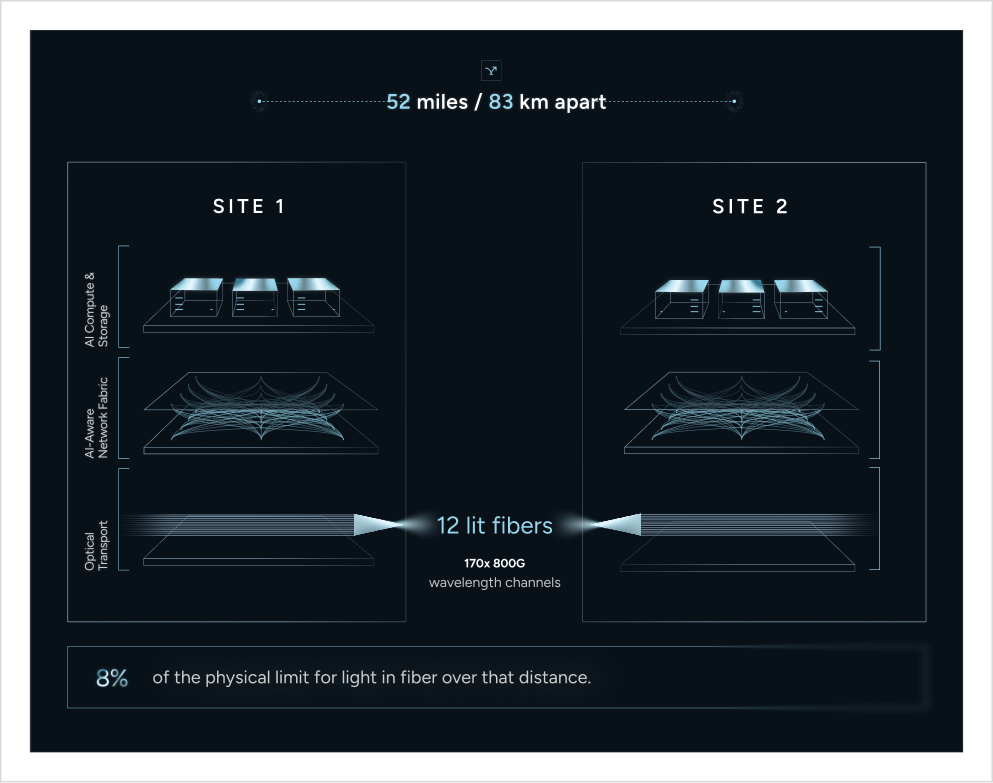
Continuum links two HITRUST-certified QTS facilities, 83 kilometers apart, over 12 Zayo dark fiber strands, running on DriveNets AI Fabric for the network layer and WEKA NeuralMesh for data and memory infrastructure across the cluster. The result is one logical GPU supercluster spanning two physical sites - not two clusters stitched together with a fast pipe between them. Networking, storage, and compute engineered together, not bolted on after the fact.
"WhiteFiber Continuum is the infrastructure answer to a problem the industry has lived with for years: geographic distance as a ceiling on what a cluster can do. Today we are making it commercially available to enterprises that need AI compute to perform at scale, hold up under compliance requirements, and not break when a single site has a problem."
— Sam Tabar, Chief Executive Officer, WhiteFiber
Why This Matters
Most infrastructure treats a data center as the boundary of a cluster. We treat it as an implementation detail.
For years, if you wanted resilience across sites, you accepted a colder, slower failover. If you wanted to scale training beyond one campus's power envelope, you stood up a second, separate deployment and lived with the coordination overhead. If you needed to keep sensitive data inside one jurisdiction, you accepted a ceiling on how large a compliant cluster could get. Continuum was built to take those tradeoffs off the table so that scale, resilience, and compliance stop competing with each other.
Because no single site is a single point of failure, a training run continues even when one location goes down, rather than stalling until it's restored. And because sensitive workloads never have to leave the site where they originate, regulated enterprises get that resilience without giving up data sovereignty.
Who This Is Built For
A few of the teams we're already talking to about Continuum:
- Foundation model labs and AI research orgs whose training runs exceed a single site's power and space envelope, and want to scale training across sites as one logical cluster.
- Regulated enterprises in finance and healthcare that need instant, active failover without giving up in-region data residency.
- Telecom and edge infrastructure partners sitting on distributed power and fiber capacity, turning it into monetizable inference capacity instead of stranded infrastructure.
- GPUaaS and NeoCloud providers that need to offer elastic scale and uptime SLAs to their own customers without building multi-site infrastructure themselves.
- Teams that already run compute elsewhere and want a lighter-weight active or warm-standby resiliency layer - AI disaster recovery, sold on its own.
Built With the Right Partners
Continuum was built in collaboration with DriveNets, which provides the high-performance AI network fabric connecting both sites, and WEKA, which provides high-performance data and memory infrastructure across the cluster. Both partnerships are central to the commercial offering.
"WhiteFiber's Continuum shows what becomes possible when ambitious engineering is paired with the right networking architecture. DriveNets' Ethernet-based AI fabric delivers the highest performance even in the most demanding, high-bandwidth, low-latency environments, ensuring scale-across superclusters move data efficiently, maximize GPU utilization, and optimize power efficiency."
— Yossi Kikozashvili, VP Product and GTM – AI Infra, DriveNets
"The industry has treated distance as a hard ceiling on AI infrastructure, and WhiteFiber Continuum breaks it. But a supercluster is only as unified as its data. WEKA's NeuralMesh gives Continuum a single, high-performance storage and memory foundation across sites, so GPUs that sit many kilometers apart operate as if the data were local. This is what turns two data centers into one engine, and what the next generation of AI innovation will be built on."
— Liran Zvibel, Co-founder and CEO, WEKA
What's Next
We designed Continuum to extend, not just to connect two sites. Additional sites can join the same logical cluster over time, using the same networking approach already in place, so the infrastructure investment compounds rather than depreciates. Full-fiber spectrum testing is underway now to confirm guaranteed commercial specifications, and we'll share more as those results land.
Let's Talk
If distance is what’s standing between your AI infrastructure plans and where you actually need to be, Continuum is live today. Visit the product page to see how it works, or join us on October 14, 2026 for a live webinar with DriveNets and Weka, where our engineers will walk through the architecture and take questions.
FAQ
What is WhiteFiber Continuum?
WhiteFiber Continuum is our cross-data-center networking solution that links geographically separated data centers into a single logical GPU supercluster, eliminating bandwidth and throughput as constraints on where and how AI infrastructure is deployed.
How is this different from just connecting two data centers with a network link?
A standard link between two facilities still behaves like two separate systems - workloads get split, jobs get coordinated across a slower connection, and failover usually means a delay while traffic reroutes. Continuum, built on DriveNets AI Fabric and WEKA NeuralMesh, makes two physical sites operate as one logical cluster, so a job can run across both sites, or fail over from one to the other, without that performance hit.
What kind of performance can I expect?
In R&D testing, the architecture delivered 111.2 Tbps of bandwidth at 0.9 milliseconds of round-trip latency across 83 kilometers of dark fiber within 8% of the physical limit for light in fiber over that distance. Full-fiber spectrum testing is underway now to confirm guaranteed commercial specifications.
Does this compromise data sovereignty or compliance?
No. Continuum is built to keep sensitive workloads within their originating jurisdiction even while failover and pooled compute happen across sites, so regulated enterprises get resilience without giving up data residency.
Who is WhiteFiber Continuum built for?
Foundation model labs and AI research teams, regulated enterprises in finance and life sciences, telecom and edge infrastructure partners, GPUaaS and NeoCloud resellers, and any team that wants active-active or warm-standby disaster recovery for AI workloads.
Is Continuum available today?
Yes. WhiteFiber Continuum is commercially available as of September 23, 2026. Visit whitefiber.com to get started.
What's next for Continuum?
We built Continuum to extend. Additional sites can join the same logical cluster over time using the same networking approach already in place. We'll share more on expansion and roadmap in the months ahead.

.svg)
