
What Are the Key Considerations When Setting Up a Private Cloud in an Air-Gapped Environment?
Key considerations for building a private cloud in an air-gapped environment, covering security, networking, updates, and operations.
15 min read
Last updated:
January 26, 2026
.webp)
Air-gapped environments represent one of the most stringent security postures for private cloud infrastructure. These networks are physically isolated from external connections like the internet, which makes them necessary for sensitive workloads in defense, healthcare, financial services, and research facilities. The isolation creates operational challenges that differ from standard private cloud deployments.
The setup process requires planning around dependency management, software distribution, and ongoing maintenance. Unlike internet-connected infrastructure where images and updates can be pulled on demand, every component must be transferred manually through physical media or controlled network boundaries.
Container registry infrastructure
GPU compute demand has outpaced supply across most sectors. Public cloud providers allocate their GPU inventory based on existing usage patterns and contractual commitments, which puts new or expanding AI programs at a disadvantage. Organizations in regulated industries face an additional constraint: compliance and data sovereignty requirements that prevent them from using public cloud infrastructure for sensitive workloads.
The data shows this clearly. Research from EY found that 62% of public sector executives cite data privacy and security concerns as barriers to AI adoption. In life sciences, only 9% of companies report feeling prepared to manage governance and compliance risks from generative AI, despite 93% acknowledging those risks exist. Financial services organizations identify compliance problems from opaque AI processes as a significant issue, with 84% reporting challenges in this area.
Cost structures add another layer of complexity. The decision between capital expenditure and operational expenditure models affects how quickly organizations can move forward with AI infrastructure. Teams that need to justify large upfront capital investments face longer approval cycles compared to those that can structure spending as ongoing operational costs.
Organizations also confront a skills gap. Designing, deploying, and managing GPU clusters requires specialized expertise that exceeds current supply. The infrastructure stack for AI workloads differs substantially from traditional enterprise IT, spanning everything from liquid cooling systems and high-density power distribution to network fabrics optimized for GPU-to-GPU communication.
Software and dependency management
Software transfer into the air gap follows a formal process. Components are downloaded on an internet-connected machine, scanned for vulnerabilities, checksums are verified, then transfer occurs via approved physical media. For Kubernetes deployments, this means downloading container images, extracting them with tools like jq, and exporting them using docker.
Operations teams work from documented procedures covering approved external repository sources, package integrity verification before transfer, security scanning requirements before crossing the gap, and software versioning and cataloging. Transfer mechanisms vary by security requirements. Options include USB drives with chain-of-custody tracking, data diodes permitting one-way data flow, or optical media for higher security deployments.

Network architecture decisions
Air-gapped environments still require internal network architecture. IP addressing schemes require careful planning since external service integration isn't readily available later.
Google Distributed Cloud air-gapped provides native IP address management, multi-zone load balancing, and workload-level firewall policies. These capabilities represent standard requirements for air-gapped architectures.
For Kubernetes clusters, architecture includes pod and service CIDR ranges that avoid conflicts with internal networks, DNS resolution without external DNS servers, certificate authority infrastructure for internal TLS, and time synchronization without internet NTP servers.
Some implementations use bridge systems at network boundaries for controlled data transfer while maintaining isolation. Bridges may run vulnerability scanners or serve as staging areas for software packages.
Hardware and infrastructure planning
Physical infrastructure considerations differ from cloud-based deployments where scaling occurs through provisioning additional instances. Compute, storage, and network requirements are calculated upfront. Data centers support high-density power, with cabinets handling 50kW+ for GPU deployments, which applies to AI and machine learning workloads common in air-gapped environments.
Update and patch management
Patching air-gapped systems involves more manual processes than connected environments. Updates are performed at least quarterly, though monthly is preferred, with comprehensive scans run after plugin updates.
The update pipeline typically includes monitoring security advisories and releases outside the air gap, downloading and testing updates in a connected staging environment, transferring tested packages across the air gap, deploying to internal staging clusters, and promoting to production after validation. This process extends timelines from hours to weeks. Security response plans account for this delay through compensating controls.
For Kubernetes environments, images for system-upgrade-controller and kubectl must match version requirements. Version tracking prevents upgrade process failures.
Initial cluster bootstrapping
Starting a Kubernetes cluster in an air gap requires pre-positioning all binaries and images. This includes the Kubernetes component containers, CNI plugin containers, and any workload containers.
The bootstrap process includes transferring Kubernetes binaries to all nodes, setting up the container runtime (typically containerd), loading container images into the runtime or local registry, configuring networking without external DNS, initializing the control plane, and joining worker nodes. Dependencies cannot be fetched during installation. Complete testing in a connected environment establishes comprehensive inventories of required components.
Orchestration and automation tooling
WhiteFiber environments support Kubernetes, Slurm, Terraform, or custom orchestration tooling (explore compute infrastructure options). Organizations select their stack before deployment and ensure all components are available.
Infrastructure as code requirements include Terraform or similar tooling with all providers pre-downloaded, Helm charts stored in internal repositories, Ansible playbooks or configuration management tools, and CI/CD pipeline tools that operate disconnected. Internal Git repositories support code management within the air gap. Development teams work on infrastructure without external transfers for routine changes.
Security and access control
WhiteFiber provides complete access control through IAM integration, audit logging, and physical isolation (view Private AI security features). Security architecture addresses identity and access management through authentication without external identity providers, role-based access control for all services, audit logging of administrative actions, regular access reviews, and separate credentials for different privilege levels.
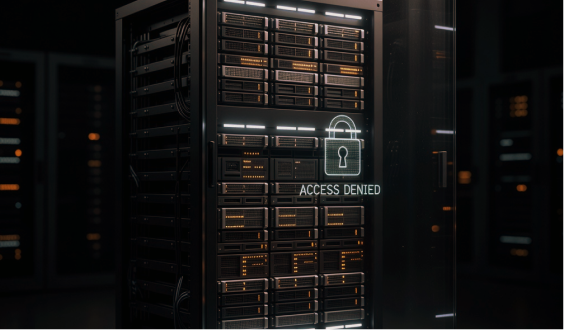
Data protection includes encryption at rest for storage systems, TLS for inter-service communication, key management systems independent of external KMS, certificate lifecycle management, and infrastructure-level data classification enforcement. Physical security controls are fundamental since isolation depends on preventing unauthorized physical access to systems.
.webp)
Monitoring and observability
Comprehensive monitoring addresses the inability to easily engage external support. Metrics, logs, and traces remain within the air gap. Full observability stacks include Prometheus, Grafana, Elasticsearch, or equivalent tools.
Monitoring tracks infrastructure health metrics for all nodes, application performance indicators, security events and anomalies, resource utilization for capacity planning, and internal network traffic patterns. Google's distributed cloud offerings include observability services as part of their platform. Long retention periods for logs support pattern detection and incident investigation without external threat intelligence correlation.
Compliance and regulatory requirements
Google Distributed Cloud air-gapped meets technical requirements for ISO 27001/27017, SOC II, ISMAP, NIST, and NATO standards. Compliance frameworks influence architecture decisions. Common frameworks include:
- NIST 800-53 for federal systems
- FedRAMP High for classified government workloads
- ITAR for defense-related technical data
- Healthcare regulations in certain jurisdictions
- Financial sector requirements for trading systems
Each framework specifies technical controls. NIST 800-53 requires configuration baselines, security assessment procedures, and incident response capabilities that function without internet access.
Backup and disaster recovery
Distributed Cloud provides an integrated backup solution for data recovery with the ability to control data residency in local or remote data centers. Backup strategies address physical location of backup copies, backup transfer between air-gapped sites, recovery time objectives without cloud backup access, and recovery procedure testing in isolation.
Local backup storage requires sufficient capacity for retention requirements. Off-site backups for disaster recovery involve coordination for physical media movement between secure locations. Some organizations maintain multiple air-gapped sites with dedicated isolated network links for replication.
Long-term operational considerations
Air-gapped private cloud operation requires different staffing and skills compared to connected environments. Teams require knowledge across all stack layers for troubleshooting without external documentation access in real-time.
Organizations allocate resources for training, specialized staff, and time for system maintenance. Infrastructure involves higher capital costs for physical hardware versus consumption-based services. WhiteFiber data centers offer expansion capacity up to 24MW+ (learn about AI infrastructure scalability).
Documentation requirements exceed connected environments. Internal knowledge bases and runbooks cover common scenarios and procedures. Downloading distributed cloud documentation for offline use represents standard practice for critical tools.
Air-gapped deployments provide strong security boundaries with corresponding operational complexity. Success depends on thorough planning, appropriate tooling, and teams prepared for disconnected operation constraints. WhiteFiber delivers dedicated AI infrastructure in sovereign environments giving regulated enterprises full control and clear compliance for organizations requiring isolated deployments.
Frequently asked questions
How do you handle emergency security patches in an air-gapped environment?
Can you run managed Kubernetes services in an air-gapped environment?
What happens when you need to scale compute resources quickly?
How do development teams work efficiently without access to external package repositories?
What is the typical timeline for deploying a production-ready air-gapped private cloud?


.svg)
