
Colo-Based AI Environments that Survive Audits and Outages
GPU-dense colo adds audit surface most providers aren't built for. Learn the controls, evidence, and recovery practices to stay compliant under SOC 2, HIPAA, and EU AI Act.
15 min read
Last updated:
June 16, 2026
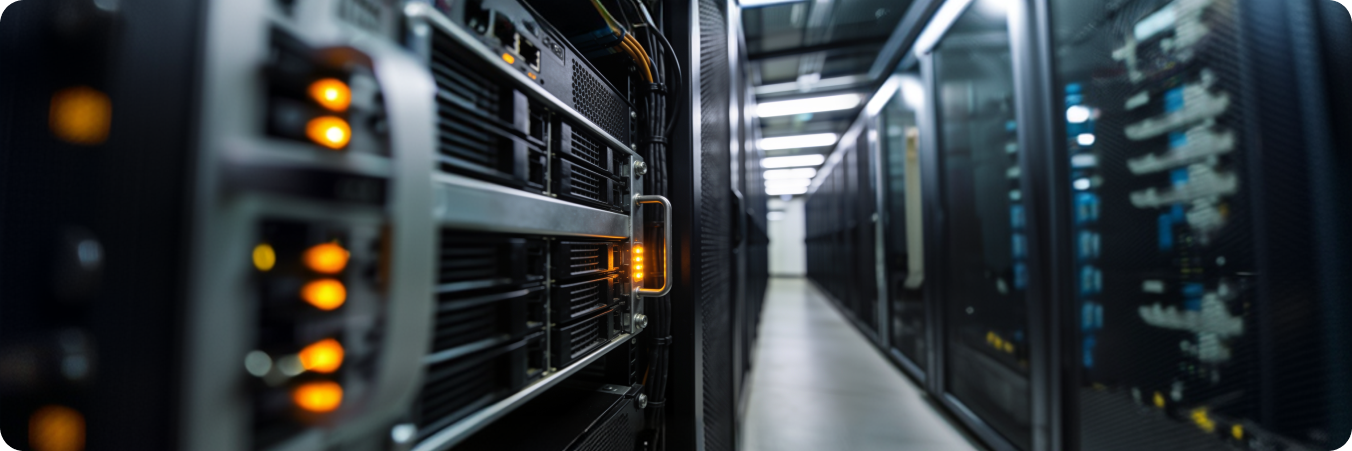
GPU-dense colocation creates more things to audit. Most colo providers are not built to run all of them. That gap shows up as findings. GPU‑dense environments create more things to audit. These include physical access, high‑density power and cooling, fabric change control, and platform governance. Most colo providers are not set up to run all of these controls day to day, making provider selection for AI workloads critical. This article explains the controls, evidence artifacts, and outage recovery practices that make a GPU colo environment audit‑ready under frameworks such as SOC 2 Type II, HIPAA, and the EU AI Act.
What "audit-ready" means for GPU colocation
Most organizations getting ready for a compliance review rush to gather logs, diagrams, and access records in the weeks before the auditor arrives. That rush has a name: audit‑prepared. However, it is not the same as audit‑ready.
An audit‑ready colocation (colo) AI environment is one where evidence is created all the time as part of normal work. Controls are in place and working. Logs are kept automatically. Recovery steps are tested and written down. So, when an auditor asks for proof, the answer already exists.
When auditors test a GPU colo environment, they focus on three areas:
- Security and access accountability: Who can enter the site, touch the hardware, or access the management plane, and can you prove it?
- Integrity and traceability: Can you show what changed, when it changed, and who approved it, across the full stack from the facility to the platform?
- Availability and tested recovery: Can the environment handle a disruption without breaking policy, and do you have records that show it was tested?
Physical colocation gives organizations something that a shared cloud environment cannot. An auditor can walk the data center floor, inspect power paths and cooling systems, and verify controls in person. Because of that, auditability is one of the strongest reasons to keep sensitive AI workloads in a dedicated colo facility.
Example: A regulated financial institution trains fraud‑detection models on customer transaction data. Auditors may need to physically verify access controls, review power‑path documents, and confirm that training jobs can restart from a checkpoint after a maintenance event. A generic cloud portal cannot meet those needs.
Controls auditors expect in compliant AI infrastructure
Controls in a colo AI environment span four domains: physical access, power and cooling, network security, and platform governance. Each domain has clear requirements. If you have a gap in any one of them, it will likely show up as an audit finding.
One tradeoff is worth stating early. High‑density GPU racks can draw up to 150 kW per cabinet. To handle that, many sites use direct‑to‑chip liquid cooling (DLC). However, DLC adds audit surface area that air‑cooled setups do not have, as liquid cooling systems require additional monitoring and maintenance procedures. In other words, more density means more controls. That is not a reason to avoid DLC. Instead, it is a reason to plan for it.
Physical access and personnel controls
Physical security is where auditors start, and where most AI colo environments are already covered. The gaps show up in the layers below. It is also a baseline requirement for both SOC 2 compliant colocation and HIPAA compliant AI hosting.
The minimum set of controls includes:
Badging with multi-factor authentication (MFA):
Stops unauthorized entry that would happen with stolen credentials alone
Mantraps: Creates a controlled entry point that prevents tailgating
Closed-circuit television (CCTV) with documented retention: Provides visual proof, often kept for at least 90 days
Escorted visitor rules with approval logs: Makes sure all non-authorized people are supervised and recorded
Chain-of-custody procedures for drive removal and hardware RMA: Tracks media from removal through destruction or return
Power and cooling resiliency controls
Power and cooling controls show that the environment can run GPU workloads without interruption. For high‑density colocation for AI, this typically means 2N power distribution (two independent power paths from the utility to the rack) and N+1 cooling (one extra cooling unit beyond the minimum needed).
However, redundancy alone is not enough. Auditors also want proof. Uninterruptible Power Supply (UPS) and generator tests should run on a documented schedule, and the results must be kept. Power Distribution Unit (PDU) and breaker panel maps must show the full power path for every GPU node.
For liquid cooling data center services, the required documentation grows:
Inspection procedures: Regular visual checks for leaks or pressure issues
Leak-response runbooks: Step-by-step steps for containment and repair
Coolant maintenance logs: Chemistry tests and flow-rate checks on a set schedule
Environmental telemetry retention: Temperature, pressure, and flow data kept for the audit period
Network security and change controls
Network controls for GPU colocation services are often stricter than for traditional server setups. Fabric changes, such as spine reconfigurations, port assignments, and InfiniBand (IB) partition updates, need the same change‑control rigor as server changes. This is also where many AI colo environments fall short.
Segmentation using Virtual Routing and Forwarding (VRF) or Ethernet VPN (EVPN) separates tenant traffic. Access Control Lists (ACLs) enforce traffic rules at ingress and egress. In addition, the management plane should require authenticated access through jump hosts with MFA, using TACACS+ or RADIUS for centralized authentication.
Each configuration change needs a ticket. That ticket should show who made the change, what changed, and when it happened. Versioned configurations also support rollback. Together, these logs are what separate compliant AI infrastructure from infrastructure that only looks compliant on paper.
Platform governance controls
Platform governance is where AI compliance starts to differ from traditional IT. Role‑Based Access Control (RBAC) limits cluster and project access based on job role. Workload isolation separates tenants or business units that share the same infrastructure. Jobs that touch restricted datasets need approval gates before they can run. Model and data lineage exports track the full lifecycle, from training data to deployed models.
This layer is where HIPAA’s minimum‑necessary access rule and the EU AI Act’s risk management expectations show up in real operations, not just in facility controls.
Evidence auditors ask for in colo AI environments
Controls without evidence are only policies. The table below links each control domain to the artifacts auditors ask for and how long to keep them.
| Control domain | Evidence type | Retention guidance |
|---|---|---|
| Physical access | Visitor logs, badge records, CCTV policy | Align to SOC 2 / HIPAA audit period |
| Power and cooling | UPS/generator test results, BMS/EPMS telemetry exports, MOP/EOP records | Match maintenance window cadence |
| Network | Diagrams, VRF/VLAN assignments, ACL snapshots, TACACS/RADIUS auth logs, change tickets | Per change event plus periodic snapshots |
| Storage and continuity | Checkpoint schedules, restore test results, snapshot immutability confirmation | Per RPO target |
| Platform governance | RBAC matrices, job isolation settings, lineage exports, approval records | Per audit cycle |
| Data residency | Contractual residency terms, egress control logs, scheduler placement records | Continuous for sovereign workloads |
The goal is a repeatable evidence binder. This means timestamped exports from Building Management Systems (BMS), Electrical Power Monitoring Systems (EPMS), network controllers, and platform telemetry. Most importantly, that binder should be built automatically, not by hand right before each audit. Manual assembly is a process risk, and auditors spot it quickly.
For sovereign AI cloud deployments, or for workloads with cross‑border limits, the residency row is not optional. Scheduler placement logs and egress controls must show that restricted jobs never left the approved jurisdiction. A contract clause that claims residency is not enough without the logs to back it up.
Outage survival without compliance drift
An outage that forces an undocumented workaround is not only an operations problem. It is also a compliance event. These are the same issue viewed from two angles. If you fix one without the other, you still have risk.
Fault domain design is the foundation. The goal is to make sure no single failure forces an undocumented response:
- Dual PDUs and feeds per rack
- Diverse cooling paths for GPU pods
- Redundant spine switches in the network fabric
- Storage head redundancy to support checkpoint writes during controller failures
Yet hardware redundancy is only part of the story. AI workloads also need specific recovery features. Frequent, size‑bounded checkpoints reduce data loss during a disruption. A defined preemption policy sets which jobs pause when resources get tight. Storage I/O headroom reserved for recovery helps avoid restart bottlenecks. Documented restart steps make recovery consistent and repeatable, instead of improvised.
To prove continuity to auditors, you need more than a Disaster Recovery (DR) plan. You need DR drill reports that show real recovery. You also need RTO and RPO attainment records that prove targets are realistic. In addition, you need change records tied to failover events to show recovery followed the written process. An untested DR plan is not a DR plan.
Consider this: A liquid cooling maintenance event needs a planned 20‑minute power reduction on a GPU pod. Without a pre‑approved Method of Procedure (MOP), a checkpoint policy, and a restart runbook, that 20 minutes can turn into an undocumented configuration change, a lost training job, and a missing gap in the environmental telemetry record. That is three separate audit findings from one planned event.
How we build audit-ready AI colocation
We build audit‑ready environments as matched systems. Power, cooling, network, storage, and platform operations must work together. Our SOC 2 Type II certified facilities support up to 150 kW per cabinet with direct liquid cooling, supported by 2N power distribution and an N+1 cooling design.
Network fabric options include InfiniBand and high‑throughput Ethernet. We choose based on workload needs. Storage systems are sized to keep GPUs busy while still keeping checkpoints consistent. Platform operations connect with facility controls so we can create one evidence pipeline that runs all the time, not only before audits.
For organizations that need the same controls across private and cloud environments, our colocation integrates with WhiteFiber Cloud to support hybrid deployments. Managed AI infrastructure services provide 24/7 engineer access for teams that need strong operations without building a full internal staff. Private AI cloud infrastructure deployments give enterprises the control their workloads and compliance programs require.
Talk with our engineers to define controls, confirm performance targets, and build an evidence pipeline that can survive both audits and outages.
Colocation Playbook for Highly Regulated Industries
Explore how colocation can help regulated organizations strengthen security, meet compliance requirements, and build a more resilient foundation for long-term growth.
Access playbook
FAQS: Colo-Based AI Environments that Survive Audits and Outages
Which compliance frameworks apply to GPU colo AI environments?
SOC 2 Type II Common Criteria is the most common baseline for enterprise AI colocation. HIPAA‑aligned safeguards apply when processing Protected Health Information (PHI). PCI DSS applies when card data environments are adjacent. EU AI Act provisions apply to organizations that deploy AI in EU markets. Most regulated enterprises must cover at least two frameworks at the same time. Because of that, control mapping matters. One control that satisfies multiple framework needs can reduce operational overhead a lot.
How is data residency proven in a colo AI environment?
Residency proof needs four layers working together: contractual terms that name the jurisdiction, key custody statements, routing and egress controls that block cross‑border data movement, and scheduler placement logs showing restricted jobs ran only on in‑region hardware. A contract clause alone will not satisfy an auditor without the supporting logs.
What does workload isolation require to pass a multi-tenant audit?
Strong isolation requires VRF/EVPN segmentation, ACL enforcement at the leaf layer, authenticated admin access via jump hosts, RBAC for GPU nodes and projects, and documented noisy‑neighbor testing with proof of fixes. Configuration alone is not enough. Auditors also expect test results that show isolation holds under load.
How does GPU colo differ from standard enterprise colo for audit purposes?
GPU colocation for AI adds audit surface area that standard enterprise colo does not have. This includes DLC maintenance procedures, high‑density power path documentation up to 150 kW per cabinet, fabric change control for IB or high‑throughput Ethernet, and platform‑layer governance for model lineage and job approvals. The compliance challenge is not harder, but it is broader. Providers without AI‑native operations experience often have gaps in these exact areas.
.svg)
